
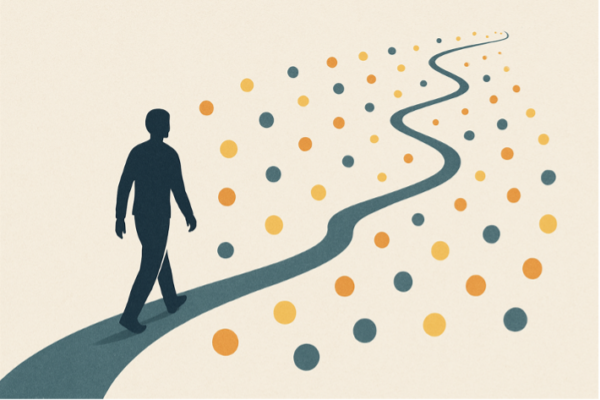
When I first graduated from college and started working, I thought wisdom was mostly about being technically smart. If you knew the details, understood the numbers, and worked hard, wisdom would naturally follow. Early in my career, I measured it by how quickly I could solve problems, how often I had the answers, and how well I performed.
It didn’t take long to realize that way of thinking only told part of the story.
Some of the most meaningful lessons in my life didn’t come from formal education or career success. They came from experience—sometimes by choice, sometimes by surprise—and often in moments that threw my plans off course or forced me to rethink what I thought I knew.
I’ve learned that wisdom doesn’t automatically come with age, a title, or more responsibility. For me, it tends to grow when I slow down, pay attention, and actually sit with what life is teaching me. I’ve always been an experiential learner. Things really sink in when I’m living them, not just reading about them. Experience has been my most honest teacher. Not always comfortable but always revealing.
Experience as a Teacher
That understanding came into sharper focus during a recent trip to Israel. While traveling, I was reading Wisdom Takes Work by Ryan Holiday, and the title resonated immediately. I enjoy learning, but what I’m most interested in is whether what I’m learning actually changes how I show up for others.
One idea Holiday explores is that wisdom isn’t something you ever fully “reach.” It’s something you practice, over and over. That felt true to my own experience. Over time, I’ve seen that wisdom tends to grow slowly—through lived experience, reflection, a bit of humility, and simply showing up consistently, not just from what we know.
I’ve also come to see that wisdom has a way of revealing itself through history. The world may look different, but the human dilemmas don’t change all that much. That became especially clear during my visit to Israel.
One of the most meaningful moments came at Masada. Standing there, I learned how Jewish families once faced an impossible choice as Roman forces closed in: surrender and live under slavery and humiliation or die on their own terms. As the story unfolded, the atmosphere felt heavy. It didn’t feel like distant history. It felt very human—a moment about dignity, control, and what makes a life worth living.
That place stirred questions many of us eventually face with the people we love, like how we balance survival with dignity, and length of life with meaning. Masada made those questions real for me. Not theoretical. Not abstract. Just human.
For my family, this wasn’t just something to think about. We had recently made the decision to move my sister to hospice, knowing that comfort, peace, and honoring her wishes mattered most. Standing there, I felt a quiet sense of confirmation. It didn’t feel like giving up. It felt like choosing dignity.
I left with a deeper appreciation that wisdom doesn’t live in books alone. Often, it shows up in places and moments where difficult choices have already been made, and where we allow those moments to shed light on our own lives.
Wisdom Through Practice
Looking back, I’ve noticed that wisdom tends to show up in ordinary moments rather than dramatic ones. It’s reflected in how we listen before speaking, how we respond under pressure, and how we treat people when there’s nothing to gain. It shows up in how we recover from mistakes and in our willingness to admit uncertainty.
Over time, I’ve come to see how much curiosity and consistency matter. Curiosity helps me stay open—asking better questions, listening more closely, and resisting the urge to assume I already know the answer. I’ve written before that one of the most powerful tools we have isn’t what we say, but the questions we ask. That’s something I still have to remind myself of, especially when it would be easier to talk than to listen.
Consistency, I’ve learned, is what allows those moments of awareness to take root. Like most things in life, progress rarely comes from big, infrequent moves. It’s shaped by quiet, daily steps that don’t draw attention but steadily move us forward. Looking back, it’s those small, repeated choices that seem to matter most in long journeys.
Reflection has also played an important role for me. Some of my clearest insights have come early in the morning or late in the evening, when the pace slows. I’ve found value in regularly looking back on the week, noticing what went well, what didn’t, and where I might want to show up differently. Those quiet pauses have shaped me more than any single event.
The Role of Humility
If there’s one quality that seems to underpin all of this, it’s humility. I’ve learned that wisdom rarely grows where certainty dominates. A mindset that has been helpful for me is reframing situations with a simple question: what can I learn from this person, this moment, or even from quietly observing the world around me. Whether it’s a conversation, a meeting, or sitting on a park bench, there is usually something there if I’m paying attention.
My natural tendency has often been to want to be the person who knows. Over time, I’ve had to consciously shift that posture toward curiosity and learning. The people who have influenced me most—mentors, colleagues, friends, and even critics—are the ones who helped me see blind spots and consider perspectives I hadn’t noticed before.
Listening hasn’t always been easy for me, but it has been instructive. I’ve come to appreciate how much wisdom depends on staying teachable, regardless of experience or position.
__________
Ryan Holiday writes, “Wisdom is a by-product of doing the right thing in the right way at the right time—not just once, but consistently over the course of a life.” That idea resonates with me. It suggests that wisdom isn’t a destination, but a practice.
I’m still learning. I still catch myself moving too quickly or reacting before reflecting. Lately, I’ve been trying to end each day by asking what I learned and how I showed up. Some days the answers are clearer than others.
What I’m coming to appreciate is that wisdom grows through practice, not perfection. It shows up in small moments, in reflection, in restraint, and in the willingness to remain teachable. I’m still very much a student of that process. But I’ve learned that when we stay curious, take time to reflect, and allow experience to do its work, wisdom has a way of finding us.