
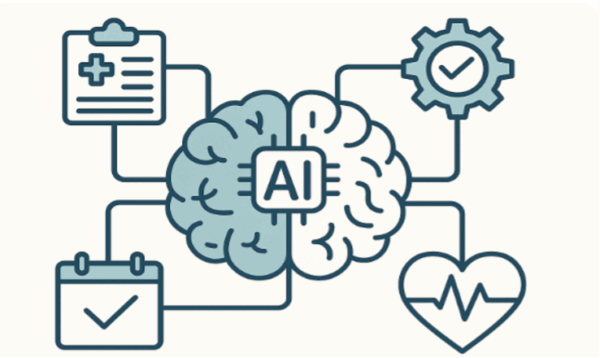
If you’ve followed my posts over the past year, you know I’ve been spending a lot of time thinking and writing about AI, how it’s reshaping the way we work and how we interact with the world around us. In one of those posts, I talked about the different stages of AI maturity, starting with simple automation, then evolving into systems that generate insights and predictions. Now we’re entering the next stage where AI doesn’t just tell us what to do, it actually helps us do it.
I’ve also emphasized that as AI advances, the human side will continue to matter more than ever. Skills like empathy, adaptability, and communication remain essential and will be what sets people apart. But this next step in AI maturity, often called agentic AI, is something we should all be paying close attention to, especially in healthcare.
So far, most of the AI we’ve seen in healthcare has been focused on improving access to information. It helps us analyze data, generate documentation, and surface diagnoses. That’s of course incredibly helpful but those systems still rely on humans to take the next step. The burden of execution, like the scheduling, the follow-ups, the coordination, etc., still falls on teams who are already stretched thin.
Which is why agentic AI feels really promising. The idea of AI that doesn’t just suggest next steps but actually takes them by closing loops and helping move things along so human energy can be focused on what really needs a human touch … things like clinical judgment, compassion, and care.
One example is Sword Health, a company I’ve been following for several years now. If you’re not familiar, Sword is an exceptionally innovative organization that’s using purpose-built consumer technology to support people with musculoskeletal and women’s health therapy.
What sets them apart is how they combine AI with advanced camera systems to guide therapy sessions right in the patient’s home. These cameras don’t just observe, they analyze movement patterns, spot potential challenges, and offer clinically informed suggestions for improvement. The result is therapy that’s more convenient, more personalized, and easier for patients to stick with.
As Sword continues to enhance the patient experience, they’ve also turned their attention to improving delivery costs and freeing up clinicians’ time. Their answer is Sword Intelligence, an AI-powered platform designed to handle the behind-the-scenes work of care coordination, a persistent bottleneck in healthcare.
Instead of adding more staff, they built AI care manager agents that run workflows. These agents enroll members, route referrals, follow up with patients, and manage the operational noise that can slow things down. The impact has been significant. Sword can now serve more patients while keeping clinicians focused on what they do best. An independent analysis found their approach delivers a 3.2× return on medical spend, saving over $3,000 per member per year. They’re now offering this technology to health systems, payers, and even governments.
From my perspective, Sword’s success comes from refusing to replicate the existing model and instead reimagining what’s possible with new devices, software, and AI. This is AI maturity in action—technology that goes beyond offering insights to actually getting meaningful work done. And in healthcare, where delays, gaps, and manual handoffs still pile on strain and cost, that’s a big deal.
Of course, with AI that acts and not just advises, careful design is critical. These systems must be secure, transparent, and built to work with clinicians, not around them. Trust matters. Guardrails matter. That means protecting patient privacy, ensuring decisions are understandable, and supporting human judgment rather than replacing it.
When those safeguards are in place, agentic AI can be transformative. It can handle repetitive, often-overlooked tasks, like following up with patients, coordinating care, prompting next steps, that, while small individually, are everywhere in healthcare. When done well, they create a smoother patient experience, faster care, and less-stressed teams.
As I’ve said before, technology rarely eliminates work, it changes it. When tractors arrived, farmers shifted from manual harvesting to managing machines, logistics, and planning. AI can do the same in healthcare by taking on the heavy lifting of routine tasks so people can focus on higher-value work — the kind that requires thought, empathy, and human connection.
_________
So here’s something to think about…
If you’re leading a healthcare organization today, especially one navigating growth, tight margins, and operational complexity, it might be time to ask: What stage of AI maturity are we operating in? Are we still relying on tools that just inform? Or are we starting to explore tools that can act?
Agentic AI isn’t just the next new thing. It’s a strategic lever. It’s a way to improve access, reduce friction, and create a better experience for both patients and providers.
And if you’re an entrepreneur or builder in this space, aim for action. Dashboards and insights are great, but what really makes a difference is helping teams get things done—automatically, intelligently, and at scale.
Sword says they’re only 5% into their vision for agentic AI. That’s a humble reminder that this space is still in the early innings. But what they’ve already accomplished shows what’s possible.
The future of AI in healthcare won’t be judged by big bangs or how clever things sound. It’ll be judged by how well new innovations work. Fewer missed follow-ups. Less administrative burden. More people getting the care they need when they need it. That’s what we should be building toward. Because it’s often the small stuff, the everyday moments when things either move forward or get stuck, that can really change how healthcare works in this country.