
From Farms to AI: What History Teaches Us About Work
I’ve always been curious about how big changes in society, especially in healthcare and technology, shape the way we live and work. Last year, I sat on a panel about AI’s impact on education, and as I prepared for it, one question kept coming to mind:
Where have we seen technology completely change the way people work before?
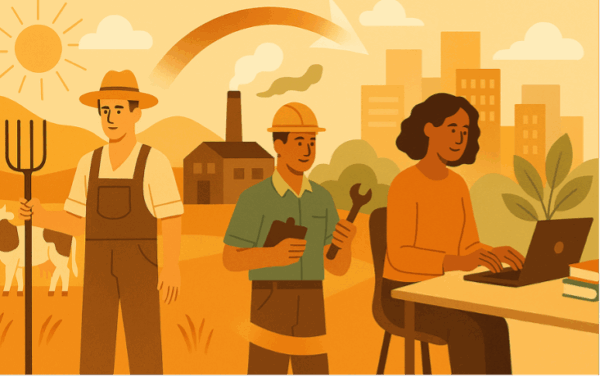
That question took me back more than a century to a time when life in America looked very different. In 1900, about 41 percent of the U.S. workforce worked in agriculture. Farming wasn’t just a job; it was a way of life for almost half the population. Today, that number is under 2 percent.
What happened? Technology happened. The arrival of tractors, irrigation systems, and mechanized harvesters changed everything. Crops that once required dozens of laborers could now be harvested by a few people and machines.
And here’s what I think is most important: this shift didn’t wipe out the workforce. It transformed it. People left the fields and went to factories during the industrial boom. Later, they moved into office jobs and service industries as the economy evolved.
It wasn’t quick, and it wasn’t easy. People had to retrain, move to new places, and adjust to completely different lives. But over time, these changes led to better living standards, more education, and entirely new industries like automobiles, telecommunications, healthcare, and finance. In fact, the U.S. labor force grew from about 29 million in 1900 to around 170 million today. And here’s the thing, most of those jobs didn’t even exist back then.
Of course, those changes didn’t just create new jobs; they changed the skills people needed. On the farm, physical strength mattered most. In offices and factories, it became about reading, writing, math, organization, and communication. This was the birth of the modern workplace.
Today’s Shift: AI and the Skills That Matter Most
Now, fast forward to today. We’re in the middle of another huge shift, this time powered by artificial intelligence. AI is already changing how we work, taking over repetitive tasks, analyzing enormous amounts of data in seconds, and helping us make decisions.
For years, success was measured by how much you could memorize or how closely you followed a process. But when AI can summarize a 300-page report or write clean code in seconds, memorization doesn’t matter as much anymore. What matters is what we do with the information … how we interpret it, apply it, and use it to solve problems.
I see this in my own life. Around our family dinner table, if a question comes up that none of us know the answer to, someone says, “Ask ChatGPT.” And within seconds, there’s the answer, clear and detailed. On a recent trip overseas, I tried Meta’s smart glasses for the first time. I looked at a historic building and asked what it was. Instantly, I got the name, the history, and the significance of it.
What both of these examples make clear is that in a world where information is always at our fingertips, the real skill isn’t memorizing facts, it’s knowing how to find what you need and what to do with it.
So, what skills will matter most going forward? After a lot of reading and conversations with experts, I’m convinced it’s the things AI can’t do easily, like critical thinking, creativity, emotional intelligence, teamwork, and ethical judgment. These are the skills that help us solve problems, build trust, and innovate.
Another big one? Digital literacy. Not in the sense of being an expert in every tool but being comfortable experimenting, trying new things, and figuring stuff out as technology evolves.
And maybe the most important skill of all is adaptability. The pace of change today is faster than anything we’ve seen before. Being adaptable means embracing change, staying curious, and learning as you go, even when things feel overwhelming or impossible.
What Leadership Looks Like Now
This matters for everyone, but especially for leaders. Adaptability is what keeps you and your team effective when everything around you is shifting. For many of us, that’s hard because leadership used to mean having the answers. For a long time, that worked, especially in industries built on predictability. But in a world where technology is constantly rewriting the rules, no leader can know everything.
Leadership today is about guiding through uncertainty, encouraging learning, and modeling adaptability. Great leaders do this by asking more than they answer, experimenting with their teams, and staying humble about what they still need to learn.
One leader I know told me how her job used to be all about control—approvals, processes, and decisions. Now, she spends her time bringing teammates together to talk about what’s working, what’s not, and what they’re learning. She still sets the direction, but the work is more collaborative and more human.
And there’s another part to this, which is empathy. When teams are adapting and learning constantly, they need leaders who understand what they’re going through, not just push for performance. Emotional intelligence isn’t just nice to have anymore. It’s a non-negotiable.
Through all of this, humility is what ties it together. Admitting you don’t know everything opens the door to learning which might be the most important leadership lesson of all.
__________
We’ve been here before. When people left farms for factories, it wasn’t easy. When they left factories for offices, it felt just as uncertain. Each shift brought discomfort, but each time, new opportunities emerged for those willing to grow.
The same is true now. Technology will change the way we work, just as machines once changed the way we farmed. The future won’t belong to those who cling to what was, but to those who stay curious, keep learning, and lead with humility. That’s how people and technology will not only coexist but thrive together and create possibilities we can’t yet imagine.